
The US is headed for bankruptcy. So declared Elon Musk.
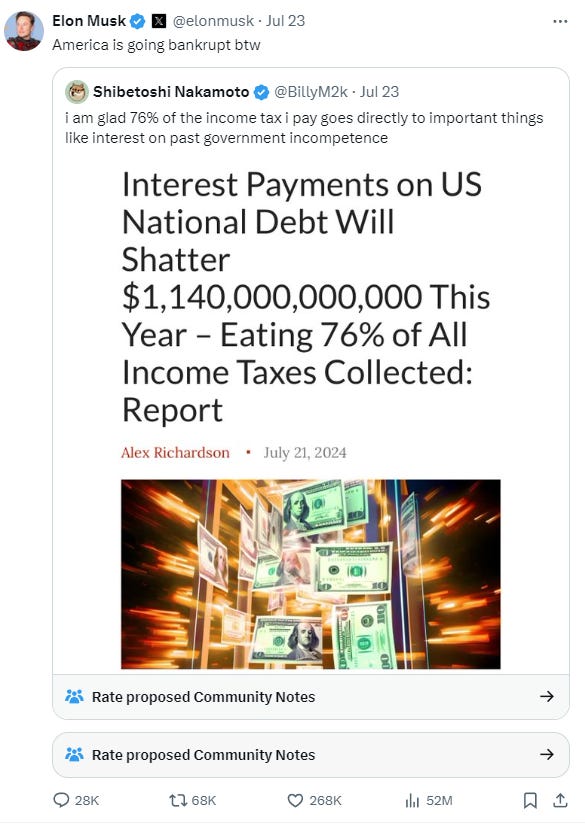
Elon Musk is known to be bombastic. So, let’s factcheck Elon Musk’s declaration. Spoiler alert: he has a point, even if he’s hyperbolic and is using some poetic license.
The US will not go bankrupt
We must first note that the US will not per se go bankrupt. Bankruptcy involves being unable to pay obligations as they fall due. The US is not in danger of this. Credit ratings agencies assess the risk of an entity defaulting on its debt. The US’s credit ratings are generally strong, being Aaa (Moody’s), AAA (Morningstar DBRS), and AA+ (S&P). Were the US at risk of default, the ratings would be worse.
Why is the US unlikely to default? It is because when the US government borrows, it borrows in USD. The US government has complete control over how much USD is in circulation. The US government can print more USD if it chooses. If the US is unable to raise money to pay for a debt obligation, it can simply ‘print more’ USD to pay that debt. For example, if the US needs to pay $100 million, it can create another $100 million. This works only because the debt is in USD and the US government can create more USD to pay that debt.
Printing money to pay debt is myopic and costly. If the US government were to print more USD to pay debt, it would severely adversely impact the US government and the economy. Elon Musk also acknowledged this.

The major costs of such money-printing are severalfold.
First, it would erase trust in US government debt. Lenders lend money on the implicit assumption they will receive the money back and that the government will not reduce the payments via money printing. Lenders cannot stop such money printing. However, if they saw the US government do so, they would simply not lend in the future. Or, they would only lend if they received inflation protection. This future cost would deter the government from printing money to erase debt today.
Second, such money printing would trigger significant inflation. Inflation is harmful because it erases peoples’ spending power and undermines their quality-of-life. Governments tend to dislike inflation because it triggers civil unrest in extreme cases, or reduces the likelihood of reelection in more moderate cases. It also triggers a vicious cycle whereby the government itself sees expenses increase in price but revenues might not increase as rapidly as wages often do not keep pace with inflation.
In short: the US will not go bankrupt. But, printing money to avoid bankruptcy is not a good solution. Rather, the US should avoid its debt obligations reaching a stage where it needs to print money to avoid bankruptcy.
The US is running a persistent deficit
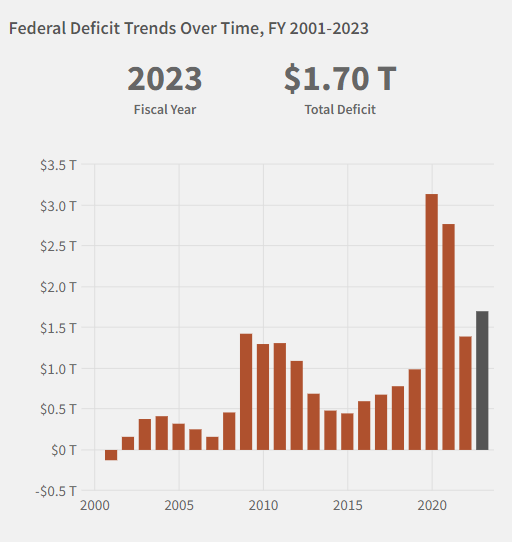
The US has run a deficit since 2002. The US last ran a fiscal surplus in 2001. A surplus is not per se good: it means the government is taking too much of its citizens’ hard earned money. However, large deficits suggest that the government is spending more money than it is earning.
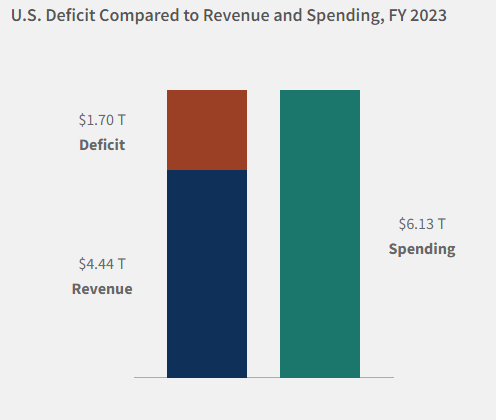
The deficit in FY 2023 was $1.7 trillion. The US spent $6.13 trillion but only brought in $4.44 trillion in revenue. Continued increases in spending exacerbate this. The spending increases arise from a combination of overseas conflicts and social security. Revenue has increased over time, but at a slower pace than have expenses.
The deficit builds on itself. This year, interest expenses are estimated to be $1.14 trillion. It already stands over $1 trillion in Q2 2024 on a seasonally adjusted annual basis. This suggests that increased interest payments from increased debt and/or increased interest rates would exacerbate the deficit. In turn, these increase the level of debt, which worsens the deficit due to interest payments.
Debt is increasing
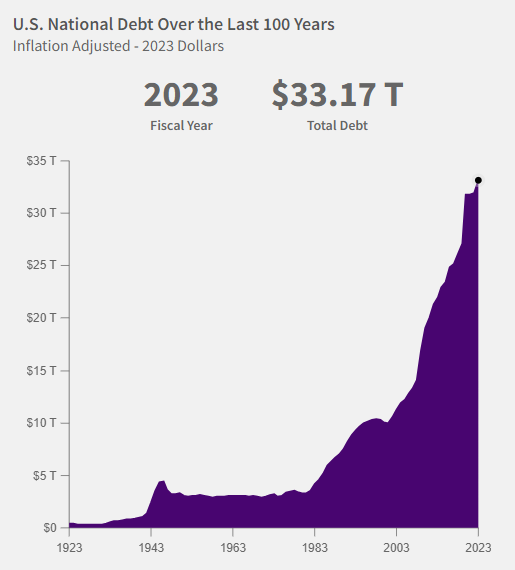
US government debt has increased both in dollar terms and as a proportion of GDP. US debt has consistently increased since 1923 and has done so in a near monotonic manner. Debt has only decreased during brief periods. Spikes in debt often coincide with significant economic disruptions, such as pandemics or overseas conflicts.
Debt has also increased as a percentage of GDP. Increases in the dollar value of debt are less harmful if the size of the economy increases by at least as much. If GDP grows faster than debt, it might (but need not) suggest the debt is increasing economic growth and is productive. However, the ratio of debt-to-GDP has also risen since the 1980s. This implies that the government is borrowing more, and is borrowing faster, than is the economy. Thus, the economy is struggling to grow itself out of its debt burden.
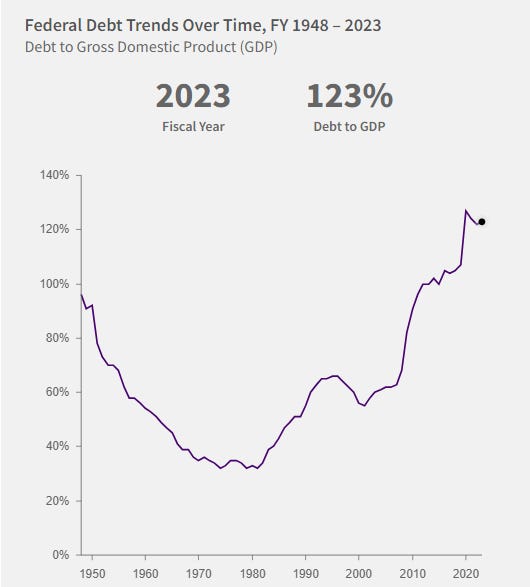
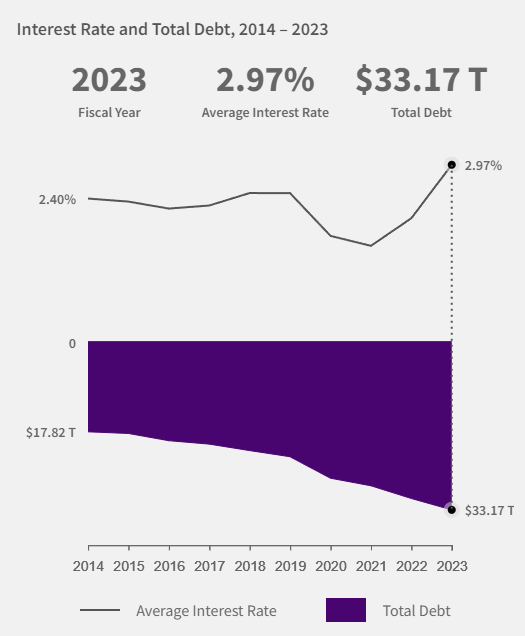
The debt burden is costly. As indicated, the debt attracts interest. This interest is an expense and worsens a budget deficit. The US benefits from the USD being the primary currency for trade and from US government debt being denominated in USD. However, interest rates remain costly. They have recently increased to an average of 2.97%. This is below the Federal Reserve’s target range of 5.25%-5.50%. This is because the interest rate is an average and reflects the interest rate on existing debt. Newly issued debt will be more costly than debt issued when interest rates were low. This is because when the federal funds rate increases, lenders will demand a rate of return that aligns with that rate on any new borrowings they give to the government. Thus, unless the Federal Reserve cuts rates, or the US resolves the level of debt and its deficit, the imbalance could worsen.
4 Where does this leave us?
The net result is that the US will not go bankrupt. But, that does not mean that the US debt and deficit situation is good. Rather, the US needs to focus on balancing the books and doing so in a way that generates growth. A good place to start is by cutting wasteful spending.