
Book review time! I thought I'd start doing them monthly-ish. This time it's "Essential Mathematics for Economic Analysis": https://amzn.to/4jBFR0i . Of course, perhaps no one will read – or care about – these and they will become less frequent. Let’s see how they go…
This month’s book spans a slightly dry subject matter: mathematics. I’ve been using it mainly as a light diversion and a ‘brain warm up’, akin to solving crossword puzzles or sudoku.
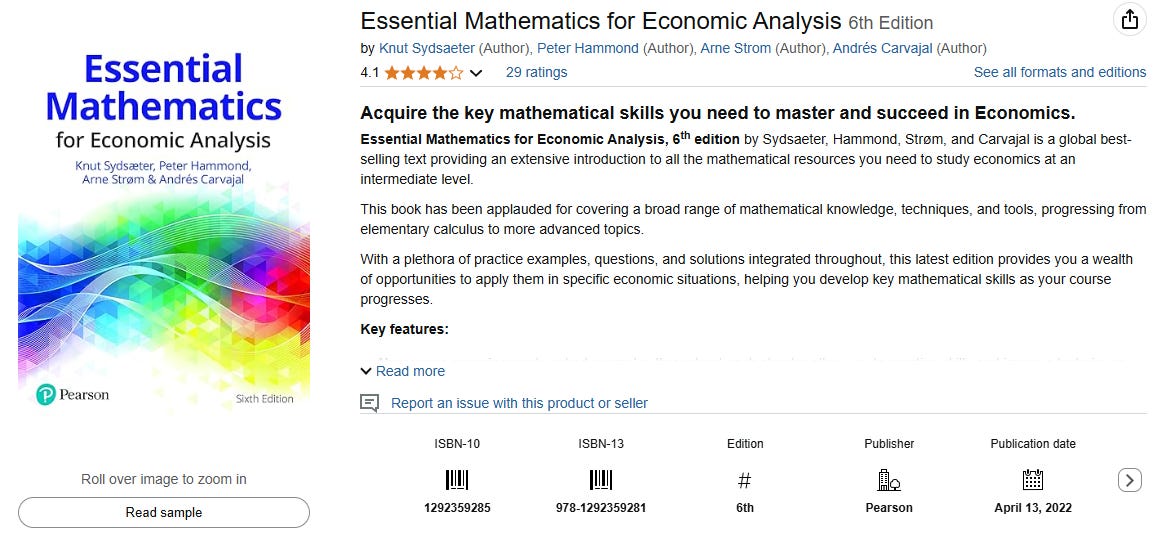
What exactly is the book?
This is a quasi-mathematics textbook. It is relatively simple. For example, it covers basic calculus, algebra, and optimization. For people who have done a PhD in economics or finance, this is second nature... until they forget the material, courtesy of disuse. The book is methodical and does not take previous knowledge for granted. This compares favorably with most economics books, which seem to assume mathematical knowledge. It is well paced. Mostly. Some sections are too long. But, they are easy to skip. The book has myriad exercises, which is mostly where my attention went.
Who is it for?
I see the book as having a few use-cases:
a) It is useful for undergrads in the field and/or for graduate students who come from more of a qualitative background. This can include as useful-to-essential reading before starting a more rigorous graduate course.
b) My use case: brain warm-up and problem solving. I do various exercise sets from it , much like you would do warm up sets at the gym. You can think of it as being similar to doing a crossword puzzle or sudoku. The material is not challenging. That is the point. It ceases to be a warm up if you actually need to think when doing the problem questions. The book is diversionary and distracting without being fatiguing. My use case – as a just a series of mini-puzzles – might be idiosyncratic.
Is it worth it?
Yes and for both the aforementioned use-cases.
For students: Unfortunately, mathematics seems to have been excised from commerce degrees. This is a problem as universities are now inflicting barely numerate ESG analysts (activists?) on industry. But, if an ESG "analyst" cannot understand the papers that analyze the relationship between ESG, its components, and returns, then that ESG analyst is useless. Don't be that ESG analyst. The mathematics are a useful counterweight as they are a precursor to understanding the empirical evidence. I posit that commerce degrees should reintroduce basic mathematics.
For my use case, it's also been positive-utility. I have gotten more than enough hours of diversion/procrastination from it. I am satisfied with the purchase and it was value-for-money.