
During the 1930s, America banned alcohol in a futile attempt to stamp out the perceived vice of drinking. But, lo and behold: prohibition merely drove drinking underground and resulted in organized crime. The policy backfired and the government eventually backflipped.
Fast forward to the present and it appears that governments still have not learned and seem not to realize that usurious taxes can backfire and do so for multiple reasons. Case in point is tobacco taxes. Australia provides a cautionary example.
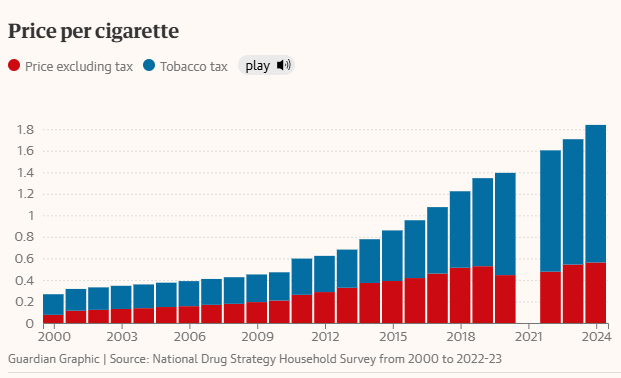
Australia has imposed extremely high tobacco taxes for many years now. The tobacco excise has increased by 282% since 2013. Wages have increased only 31% over that time period. At present, a 25-pack might cost around $50, with $34 going to the government. The tobacco excise is over half the cost of the product. Furthermore, treasurer Jim Chalmers vowed to increase the excise by another 5 percent, on top of the normal indexation, for three years.
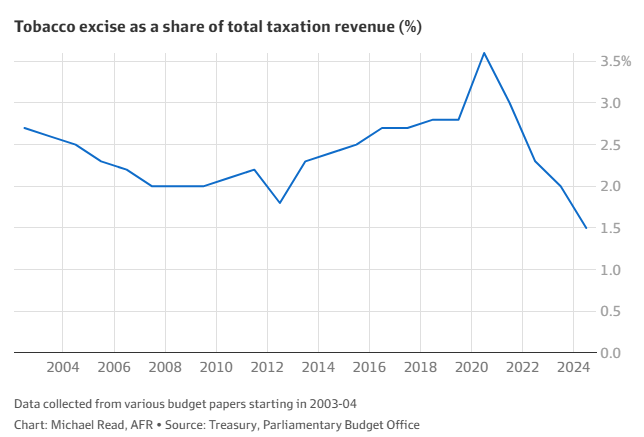
Despite an increasing tax rate, tobacco excise revenue has hit a 9-year low. This is telling. Tax rates are increasing, but the total tax take is falling.
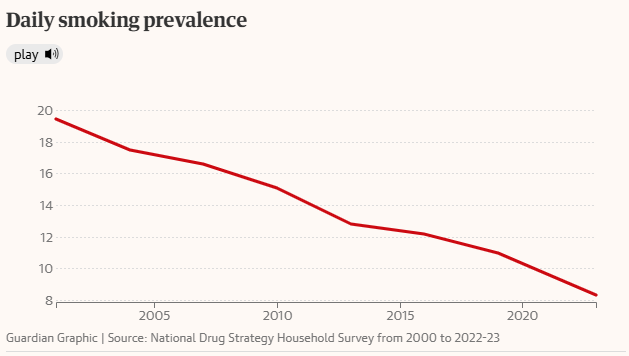
The stated rationale for the high tax rate is that high prices will force people to quit. This is based on the idea that smokers develop cancer; and thus, the tobacco excise pays for the cost of treatment. Furthermore, the government has deemed it worthwhile to encourage people to quit in order to improve their health. Certainly, it is likely that the taxes have contributed to a fall in smoking uptake.
Ironically, the government’s stated rationale is reminiscent of the Laffer curve. The higher the tax rate, the less likely a person is to work harder or risk their capital as the marginal cost of doing so, in terms of time, effort or risk, is higher than the after tax marginal benefit.
Nevertheless, given that we know the history of prohibition, we know that tobacco sales might simply have gone underground. The question is then: if tobacco tax rates are increasing, why has tobacco tax revenue decreased? There are two possible explanations:
High tobacco taxes has encouraged people to quit
People are buying ‘black market’ tobacco
Well, certainly some people have quit. But, The Australian Financial Review notes that “The Tax Office estimates a record 18 per cent of all tobacco for sale in 2022-23 was illicit, and would have earned the federal government an extra $2.7 billion if it was instead sold legally.”
There has also been a reported surge in crime related to illegal tobacco. This includes reports that criminals have firebombed retailers that have not complied with their demands. This appears to be an especial problem in Victoria, one of Australia’s most “progressive” states.
The result is clear: The high profile firebombings are anecdata. But, coupled with the alleged increase in illegal tobacco sales, it appears that taxes have forced at least some people to buy illicit tobacco. The question is then how to respond.
The major political parties have vowed to increase enforcement. The opposition has vowed to spend $250 million to increase enforcement. The opposition treasurer stated “It is clear that we need a tough cop on the beat to respond to the lack of real action from the Albanese government, which has allowed the illicit vaping and tobacco black market to thrive,”
The alternative is to reduce taxes to reduce the incentive to buy illicit tobacco and the incentive to supply it.
The path that the government has taken is no surprise. But, it’s also a recipe to make everyone’s life worse. In essence, the government becomes addicted to a revenue stream. It starts spending that stream, with recurring expenditures that are politically difficult to remove. The government then wonders why the revenue stream decreases. But, because the spending is sticky, it cannot adjust. So, the government must become more hard nosed and draconian in order to drive ever more revenue.
This is somewhat akin to the government’s approach in general. But, with general tax, the government also ignores the growth effect of taxation. As indicated before, the higher the tax is, the lower the net benefit of working more or taking more risk. But, if your spending is to increase, you need growth to finance it. So, the government strangles growth and strangles revenue, and wonders what is going wrong. It is akin to Winston Chruchill’s statement that “a nation to try to tax itself into prosperity is like a man standing in a bucket and trying to lift himself up by the handle.” And, Margaret Thatcher’s statement that “the problem with socialism is that you eventually run out of other peoples’ money”.
Government is not run by the smartest people, however. To use Australia as an example, the treasurer has never held a private sector job, has always been within the government and think-tank arena, and has a PhD in political science. His PhD thesis was a dissertation on a former prime minister – Paul Keating. His dissertation had no economics or accounting and he has no background in finance, economics, or accounting. This situation is not uncommon in Australia. It is little wonder that Australia has such failed policies.
The situation is unlikely to change, however. Australia’s approach is not uncommon. Myriad countries take a similar approach. But, Australia’s attempt to tax itself into prosperity, and its surprise at the rise in organized crime, should serve as cautionary tale.